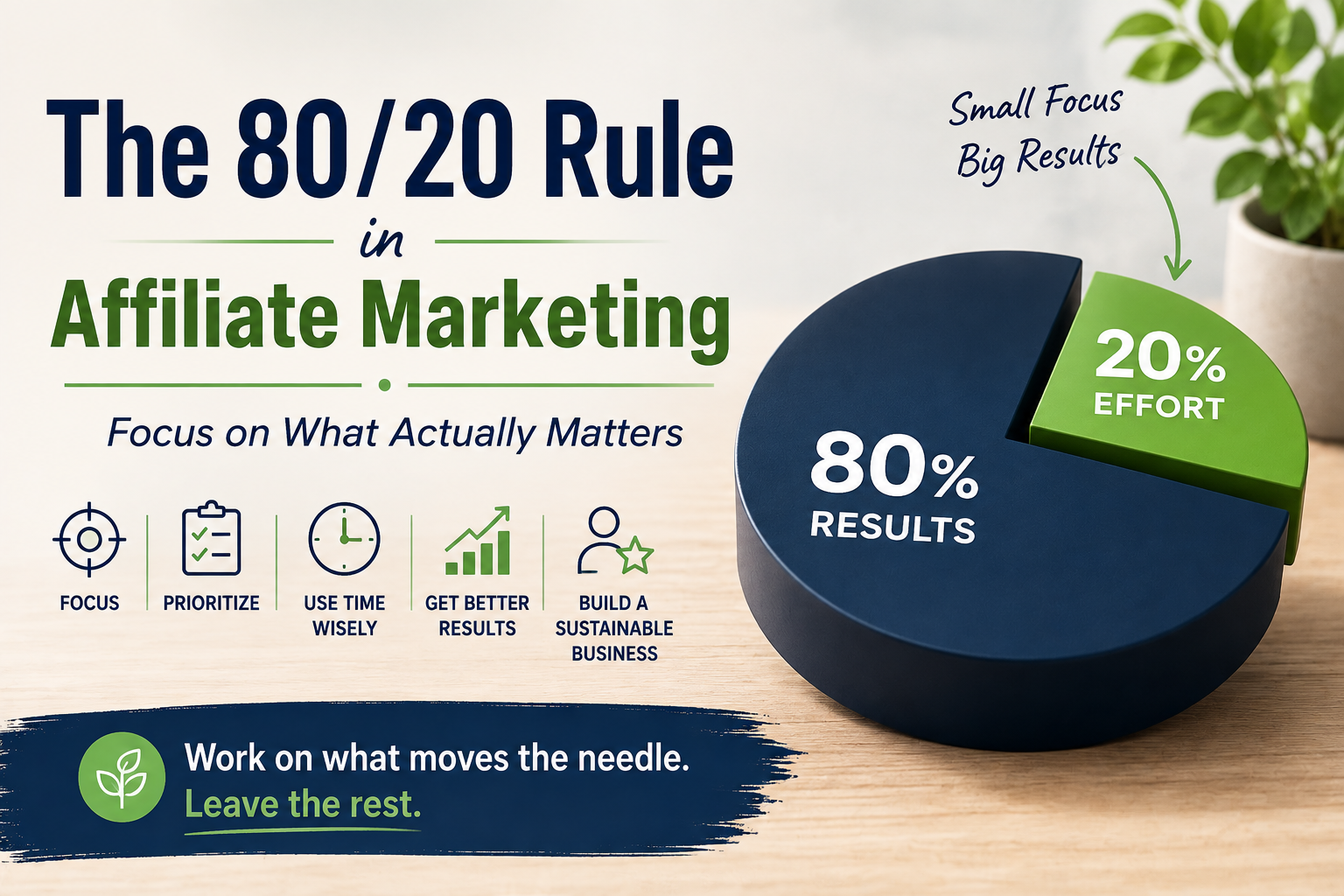

Learn how the 80/20 Rule in affiliate marketing can help you focus on productive activities, reduce distractions, and use your time more effectively.
Entering affiliate marketing can feel overwhelming quickly. Within days of deciding to build an online income stream, beginners get bombarded with advice to master search engine optimization, build complex websites, run YouTube channels, manage multiple social media profiles, construct email funnels, research keywords, buy software, and master dozens of AI productivity tools.
The immediate, exhausting question almost every newcomer asks is simple: "Do I really have to do all of this?" The answer is no. Sustainable progress in online business doesn't come from doing everything at once; it comes from identifying and executing a very small number of genuinely productive activities.
What Is the 80/20 Rule?
The concept commonly referred to as the 80/20 Rule originates from Pareto's Principle, an economic observation first noted by Italian economist Vilfredo Pareto. In practical terms, it suggests that roughly 80% of your results or outcomes flow from approximately 20% of your total inputs or efforts.
The 80/20 rule is not a rigid mathematical law or an exact scientific formula. Instead, it's a powerful mental model for prioritizing your limited time and mental energy. When applied to online publishing and entrepreneurship, it shifts the fundamental question away from "How much can I get done today?" to a far more valuable inquiry: "Which specific activities are producing meaningful, measurable progress?"
What Does the 80/20 Rule in Affiliate Marketing Mean?
When applied directly to digital publishing, the Pareto Principle reveals patterns that seasoned creators encounter every day. In many established online businesses, a relatively small number of articles, search queries, or product recommendations can account for a disproportionate share of the results.
This reality highlights a critical distinction every digital entrepreneur must understand: activity and productivity are entirely different. The issue isn't that those activities have zero value. It's that beyond a certain point, continually tinkering with them yields diminishing returns. Real progress requires clarity on what drives traffic, engagement, and trust.

The Trap of Trying to Do Everything
Beginners frequently fall into the trap of omnipresence. They are told that to succeed, they must maintain an active website, publish daily across Facebook, YouTube, TikTok, Instagram, and Pinterest, nurture an automated email list, and run paid ad campaigns. Layer on top of that a relentless cycle of new courses, plugins, and AI utilities, and the result is predictable: exhaustion, dilution of quality, and stalled momentum.
Working twelve hours a day across eight different channels does not guarantee traction. In fact, spreading effort so thinly almost guarantees that none of those channels will achieve the quality required to stand out. Growth doesn't come from working harder across a chaotic landscape; it comes from learning where your effort actually yields measurable value.
Your 20% Will Change Over Time
A beginner's productive 20% may be learning, setting up the basics, and producing their first useful content.
Six months later, it might be improving the content already attracting visitors.
Later, it could focus on the handful of products, videos, or articles producing most of the response.
The 80/20 Rule isn't about discovering five activities and doing them forever. It's about continually identifying where your effort adds the most value at your current stage.
For someone building a long-term affiliate marketing foundation, the high-leverage 20% is surprisingly straightforward. It consists of a clear, sequential path:
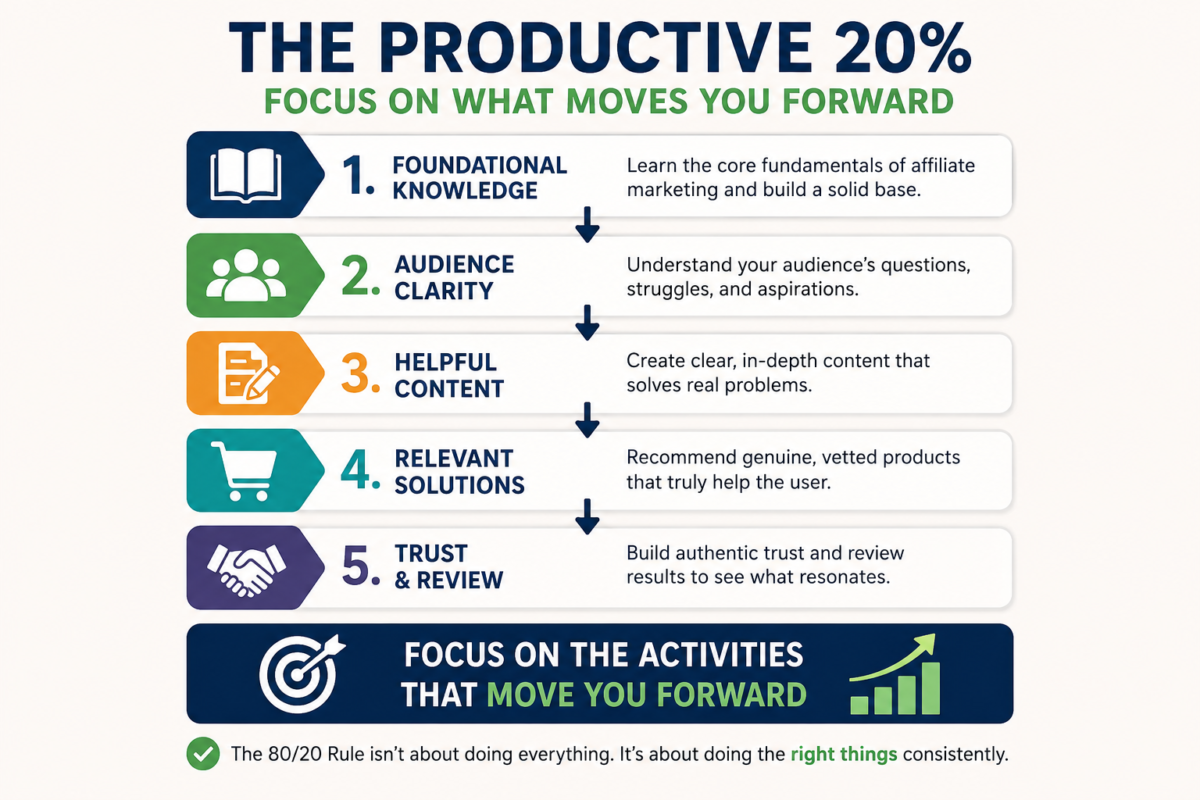
This is not an inflexible corporate blueprint, but a grounded sequence of purposeful execution. When you focus on audience research and practical problem-solving, you cut through the surrounding noise.
The Other 80%: Where Time Quietly Disappears
Just as important as identifying high-leverage tasks is recognizing where working hours quietly disappear without generating return. Most unproductive habits masquerade as productive labor:
- Constantly tweaking website layouts, fonts, and logos instead of publishing helpful material.
- Checking analytics, impressions, and affiliate dashboards multiple times a day when data has not had time to mature.
- Buying new software suites or enrolling in new training courses before finishing the practical steps already learned.
- Jumping onto every emerging social media platform or chasing new strategies simply because someone else claimed it worked for them.
None of these tasks are inherently bad in moderation. Still, when left unchecked, they quickly become comfortable substitutes for the real, slightly harder work of content creation, research, and audience connection.
Use Evidence, Not Guesswork
Separating the productive 20% from the distracting 80% requires relying on objective data rather than emotion or assumptions. Once you have published a baseline of content and given it adequate time to index and circulate, your performance data can begin to reveal useful patterns.
Tools like Google Search Console, native website analytics, YouTube dashboards, and affiliate portal reports provide unambiguous feedback. Over time, these tools can reveal patterns in where visitors come from, which content attracts attention, and which activities produce meaningful progress. Once the evidence shows what your audience values, you can reallocate your time and energy to producing more of what works.
What You Should Stop Doing
The true heart of the 80/20 rule isn't merely choosing which tasks to schedule; it is finding the discipline and clarity to stop doing things that fail to move the needle.
Real focus requires eliminating low-yield commitments. It means giving yourself full permission to ignore platforms that drain your energy without delivering readers, letting go of unnecessary daily administrative busywork, and declining to chase every shiny tool that surfaces. Sustainable entrepreneurial success is built on patience, informed decision-making, and deliberate subtraction rather than frantic, unguided activity.
A Simple 80/20 Weekly Review
To keep your workflow grounded without installing complex project management frameworks, incorporate a brief review at the end of each working week by answering three core questions:
- Where did the bulk of my time actually go this week?
- Which specific actions produced visible traction, clarity, or forward momentum?
- What single task should receive more of my attention next week—and what should I actively drop or reduce?
This simple diagnostic keeps your daily priorities aligned with real-world outcomes and prevents unproductive habits from taking root.
Affiliate marketing does not require mastering every modern marketing platform or adopting dozens of digital tools. Long-term success means gaining enough practical clarity to see which few activities move your specific business forward, and having the focus to put your energy there. Success rarely comes from doing more things; it comes from finally understanding what deserves your undivided attention.