

Introduction
Wondering how long it takes to learn an online business? Discover realistic expectations, the stages of learning, and how to build lasting skills. If you are beginning to explore the idea of building an online business, one question is almost impossible to avoid: how long is this actually going to take?
It is a completely reasonable question. When we learn to drive a car, complete an educational qualification, or master a new hobby, we usually have a clear timeline and a rough idea of how long the training process will take.
Learning an online business, however, often feels very different.
If you search online, you will find wildly conflicting answers. Some marketers claim you can master everything in a few short weeks, while others suggest it takes years before you see any meaningful progress.
So who is right?
The honest answer is that learning an online business is not a sprint with a fixed finish line. It is a gradual, highly personal process of developing practical skills, gaining real-world experience, and building confidence step by step.
The Problem With Fixed Timelines
One of the biggest mistakes beginners make when starting is searching for an exact timetable.
It makes sense to ask specific questions, such as how long it will take to understand search engine optimization, how many weeks it will take to build a functioning website, or when you can expect to earn your first affiliate commission.
The underlying problem is that everyone starts from a completely different baseline. Someone who enters this space with prior experience in professional writing, corporate marketing, photography, or traditional business management will naturally progress on a different timeline than someone learning to navigate modern digital tools for the first time.
Comparing your personal timeline to someone else's progress rarely produces anything useful. It usually leads to unnecessary self-doubt or artificial pressure, not meaningful growth.

Learning Happens in Stages
Rather than measuring your progress in strict calendar months, it is far more helpful to view your journey through distinct developmental stages. Most beginners move through a predictable path as they build their capabilities.
In Stage One, the focus is on understanding how digital business models work under the hood, demystifying the terminology, and grasping how value is delivered online.
Stage Two moves into practical implementation, where you learn to navigate basic software, website builders, and communication tools.
By Stage Three, you transition into creating your first pieces of content or setting up your foundational offers, putting theoretical knowledge into actual practice.
Stage Four builds momentum by establishing consistent daily or weekly work habits, ensuring your output becomes reliable.
Finally, Stage Five centers on refinement and growth through hands-on experience, learning to interpret real-world feedback and fine-tune your strategy.
Each stage builds on the last, and trying to skip ahead without mastering the basics only creates confusion down the road.
To help you visualize progress, here are practical milestones you might expect at each stage:
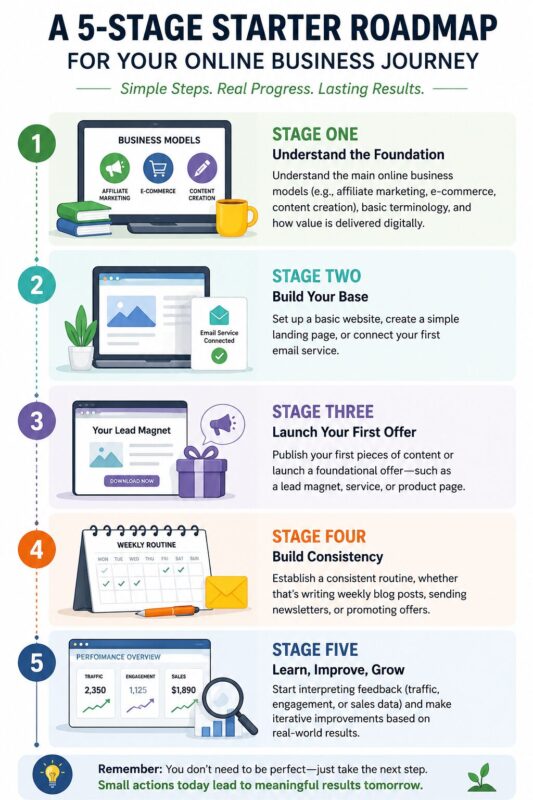
Remember, everyone's milestones will look a bit different, and the timeline is personal.
Progress Is Rarely Linear
One aspect of building a business that surprises almost every new entrepreneur is that progress is rarely a straight line moving steadily upward.
Some weeks, everything seems to click into place effortlessly—you master a new tool, write a great article, and feel a strong sense of momentum. Other weeks, you might hit a technical brick wall or struggle with creative block and feel completely stuck.
It is vital to understand that feeling stuck does not mean you are going backward or failing. Real-world learning almost always follows a natural rhythm: active progress, a quiet pause while your mind processes new concepts, a sudden breakthrough, and then the cycle repeats. The key to long-term success is to keep showing up and doing the work, even during quiet plateaus.
Why Some People Learn Faster
When you see certain individuals moving through the learning curve faster than others, it is rarely because they possess superior intelligence or secret technical talent.
More often, people who progress efficiently have structured advantages working in their favor. They usually follow a clear, proven roadmap rather than trying to figure out every step on their own. They deliberately eliminate daily distractions, seek experienced guidance to avoid common traps, keep realistic expectations about the effort required, and build steady, consistent work habits.
In digital business, small improvements made consistently every day will always outperform occasional bursts of overwhelming enthusiasm followed by weeks of inactivity.
Accelerating your learning is often easier with support. Seek out online communities, masterminds, or mentors where you can ask questions, get feedback, and stay accountable. The journey is much easier—and more enjoyable—with others on a similar path.

What I Learned
When I first began my own online business journey, I assumed the primary challenge would be technical—that learning was simply a matter of mastering software, understanding web publishing, and understanding algorithms.
Looking back with the benefit of experience, I was actually learning something much larger and far more valuable.
I was learning patience in an age of instant gratification. I learned to break complex problems into manageable steps and think like an independent business owner, not a passive consumer. Those mindset shifts and problem-solving skills proved far more valuable than any specific technical tutorial or software lesson. Like a true apprenticeship, real confidence grew through quiet practice, minor mistakes, and hands-on experience.
Stop Measuring Days. Start Measuring Growth.
Perhaps the single most liberating realization you can have as a beginner is that "How long will this take?" is actually the wrong question to ask.
A far better question to ask yourself at the end of each day is: "Am I learning something today that I didn't know yesterday?"
If your answer to that question is "yes, then you are making genuine, measurable progress. Measuring your growth by the skills you acquire and the clarity you gain—rather than counting down arbitrary calendar days—keeps your focus where it belongs: on continuous personal development.
Conclusion
Learning an online business is not about reaching a finish line as quickly as possible to prove something to the world. It is about becoming more capable, more confident, and more independent with each passing week.
Some people will move through the stages faster, while others will take a more deliberate, measured pace. In the grand scheme of things, the speed itself matters very little. What truly matters is that you keep learning, keep applying what you discover, and keep refining your craft.
If you remain consistent, one day you will look back and realize something remarkable: the digital skills and strategic concepts that once felt completely overwhelming have quietly become second nature.

In our next article, we'll compare free and paid online training to help you decide which approach best fits your goals, budget, and learning style.