

Introduction
Discover 7 side hustles for retirees and learn how to evaluate each opportunity before you commit. Find a flexible business that fits your lifestyle after retirement.
Most people searching for a side hustle after retirement aren't simply looking for extra income.
They're looking for options.
Some want greater financial security to buffer against inflation. Others want to stay mentally active, keep learning, or feel that they still have something valuable to contribute.
The internet offers thousands of side hustle ideas, from dog walking to dropshipping. So the real challenge isn't finding opportunities—it's choosing one that is genuinely worth your time.
Before committing your energy, focus, and hard-earned capital to any side hustle, it's worth understanding what separates a worthwhile opportunity from one that quickly becomes another source of frustration.

Retirement Has Changed
Retirement today looks very different from what it did for previous generations.
Many people can now expect to spend twenty or even thirty years in retirement. For some, it's a chance to slow down and rest. For others, it's an opportunity to begin a completely new chapter. People are living longer, staying healthier, and wanting to remain engaged with the world.
Building a side hustle isn't always about replacing a full-time corporate salary. Often, it's about creating:
- Purpose: Having a structured, meaningful project to wake up to.
- Flexibility: Work that bends around your family life, travel plans, and health.
- Ongoing learning: Keeping your brain sharp by mastering new concepts.
- Satisfaction: The quiet pride of continuing to grow and build.
This shift is changing the way many retirees think about work. It is no longer about trading time for a survival wage; it is about finding a harmonious blend of activity and leisure.
Don't Choose a Side Hustle Too Quickly
One of the biggest mistakes people make when entering this space is choosing the first opportunity that promises quick results or overnight passive income. It is incredibly easy to let excitement replace careful evaluation.
Most people start by asking:
"Which side hustle makes the most money?"
But there is a much better, more sustainable question to ask:
"Which side hustle fits the life I want to build?"
Shifting your thinking to this single question can save you months of trial and error and quiet frustration.
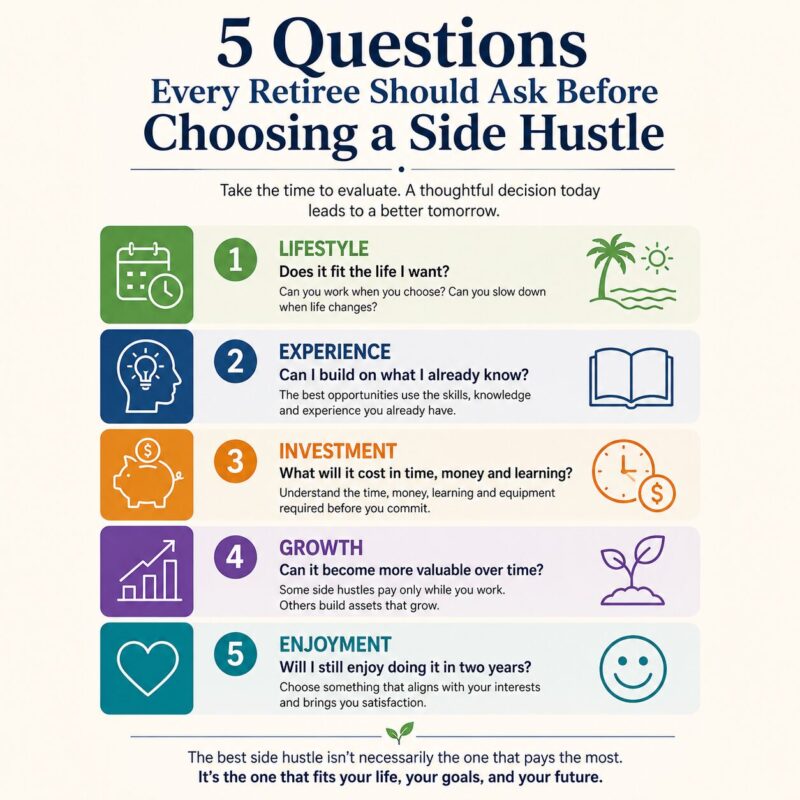
Five Questions Worth Asking Before You Start
Rather than diving headfirst into a list of opportunities, let's establish a filter. Before you commit to any business model, run it through these five evaluation criteria.
1. Does it fit your lifestyle?
Can you work when and where you choose? If you decide to take a three-week trip to visit family, does your business pause while you're away, or does it require your daily presence? A good retirement side hustle should offer the flexibility that retirement itself is supposed to provide.
2. Does it build on your experience?
Retirement doesn't erase decades of professional and life knowledge. You have developed problem-solving skills, industry insights, and strong communication skills. The strongest opportunities are those that make use of the skills, interests, and experience you already possess, rather than forcing you to start completely from scratch.
3. What does it cost to begin?
Every opportunity requires an investment. Make sure you understand the true cost of entry across four distinct areas:
- Time: How many hours a week does it realistically require to maintain?
- Money: What are the startup costs, software subscriptions, or inventory requirements?
- Learning: How steep is the learning curve before you can make your first dollar?
- Equipment: Do you need specialized hardware, or can you run it from a standard laptop?
4. Can it grow over time?
Some side hustles for retirees only pay you when you are actively working (like rideshare driving or freelancing). If you stop working, the income stops immediately.
Other models allow you to gradually build a digital asset that becomes more valuable and generates income over time, even when you aren't sitting at your desk. Understanding this difference is one of the most important decisions you will make.
5. Will you still enjoy doing it in two years?
The most sustainable side hustle isn't necessarily the highest-paying one. It is the one you will still look forward to working on once the initial novelty and excitement have worn off.
Five Types of Side Hustles Worth Considering
There is no universally "best" side hustle.
Every opportunity involves different trade-offs.
Some require you to exchange your time directly for income.
Others require patience while you build something that may become more valuable over time.
The goal isn't to find the perfect answer.
It's to understand which model fits your experience, lifestyle, and long-term goals.
Instead of declaring one path the ultimate "best," let's honestly evaluate five popular retirement side hustles, looking at both sides of the coin.
1. Consulting
If you retired from a specialized industry or professional role, consulting allows you to sell your advice rather than your hands-on labor.
- Advantages: High hourly rates; utilizes your existing professional network; low startup costs (usually just a computer and LinkedIn profile).
- Challenges: You are still trading direct hours for dollars; client management can sometimes bring back corporate stress.
- Who it suits: Retired executives, educators, engineers, and specialists who want to stay connected to their industry on their own terms.
2. Freelancing
Freelancing involves offering specific, task-based services—such as writing, bookkeeping, graphic design, virtual assistance, or proofreading—to businesses or individuals.
- Advantages: Highly flexible; high demand for reliable, mature professionals; platforms like Upwork and Fiverr make it easier to find initial clients.
- Challenges: Income can be feast-or-famine; you must actively pitch for work; project deadlines still bind you.
- Who it suits: Retirees with practical, execution-focused skills who enjoy project-based work and concrete deliverables.
3. Selling Products (E-commerce)
This involves selling physical goods (like handmade crafts on Etsy) or digital products (such as templates, e-books, or guides).
- Advantages: Turning a creative hobby into an income; potential to reach a global market.
- Challenges: Physical products require physical storage, shipping logistics, and inventory management. Digital products require significant upfront development time, and both models require ongoing customer service and marketing.
- Who it suits: Creatives, artisans, or organized individuals who enjoy product design, packaging, and digital storefront management.
4. Content Creation
Content creation involves sharing your knowledge or hobbies through a blog, a YouTube channel, a podcast, or self-published books.
- Advantages: Incredibly rewarding; allows you to connect with a global community of like-minded people; high potential for long-term passive growth.
- Challenges: Building an audience takes immense patience, consistency, and a willingness to learn basic digital tools. It can take months or even years of consistent output before you see meaningful monetization.
- Who it suits: Those who love teaching, storytelling, writing, or speaking, and are willing to play the long game.
5. Affiliate Marketing
Affiliate marketing is earning a commission by promoting other companies' products or services. When someone buys through your unique link, you receive a percentage of the sale.
- Advantages: Extremely low startup costs; no inventory to manage; no customer service or shipping to worry about; highly scalable.
- Challenges: Requires a solid understanding of how to build an online audience; requires building trust over time; has a significant technical and marketing learning curve.
- Who it suits: Retirees who want to build a highly flexible, location-independent business and are excited about learning digital marketing, writing helpful reviews, and sharing genuine recommendations.

Which Side Hustle Did I Choose?
After exploring many online business models over the years, I realized I wasn't looking for the quickest path to a transaction or the most complex model. I wanted something that aligned directly with the lifestyle I wanted to build.
I eventually chose affiliate marketing.
It wasn't the easiest option, and it certainly wasn't the fastest. But when I evaluated it against the questions we just went through, it offered the perfect combination of flexibility, low upfront financial risk, continual intellectual challenge, and the ability to build an asset that grows over time.
That doesn't mean affiliate marketing is the perfect choice for everyone. It simply became the right choice for me because of what I valued most in my post-retirement years.

Your First Decision Isn't Choosing a Side Hustle
Your first decision isn't choosing a side hustle.
It's learning how to evaluate opportunities.
Once you understand how different business models work—what they demand, what they cost, and what they can become—you stop chasing ideas simply because they're popular.
Instead...
You begin choosing opportunities because they genuinely fit the future you're trying to build.
If you are ready to take the next step in evaluating your options, these resources are designed to help you navigate the process safely and clearly:
- Evaluate Online Business Opportunities – A deeper look at how to run different business ideas through a realistic filter.
- Start Here: Online Business After 55 Guide – Our comprehensive, step-by-step roadmap for starting your online journey safely.
- Senior-Friendly Affiliate Programs – A curated list of trusted, straightforward affiliate programs that suit beginners.
- Affiliate Marketing for Beginners – A plain-English introduction to how the affiliate model works without the technical jargon.
Frequently Asked Questions
What is the easiest side hustle to start after retirement?
The "easiest" side hustles for retirees are typically service-based, like local pet sitting, tutoring, or freelance proofreading. These require almost zero startup costs and use skills you already have. However, they still require you to trade your direct time for money.
How much money can retirees realistically earn?
This varies wildly. A casual freelancer or consultant might earn anywhere from $500 to $5,000+ per month, depending on their industry expertise and hours worked. An online asset-based business (like a blog or affiliate site) can earn anywhere from a few hundred dollars to a full-time income, but it requires substantial time to build up to those levels.
Can I start with no previous business experience?
Absolutely. Most successful retired entrepreneurs did not run businesses during their primary careers. What they do have is a lifetime of communication, organization, and problem-solving skills, which are far more valuable than formal business degrees.
What if I'm not very technical?
You do not need to be a computer programmer to run an online business today. Modern website builders, writing tools, and e-commerce platforms use "drag-and-drop" simplicity. If you can send an email, use Google, and navigate social media, you have the foundational skills to learn the rest.
How long does it usually take before earning an income?
If you are offering a service (consulting or freelancing), you can start earning within weeks of finding your first client. If you are building a content-based site or doing affiliate marketing, you should realistically plan for 6 to 12 months of consistent effort before seeing steady financial returns.
Is affiliate marketing suitable for retirees?
Yes, because of its low financial risk and extreme flexibility. However, it suits only those who are patient, willing to learn how to write helpful online content, and dedicated to building authentic trust with their readers.
Conclusion
The best side hustles for retirees aren't necessarily the one that promises the highest or fastest payout.
It is the one that fits your unique experience, your genuine interests, your ideal daily lifestyle, and the future you want to create.
When you take the time to evaluate opportunities carefully before spending your money or your hours, you are far more likely to choose something you will still enjoy years from now. That slow, deliberate approach is a much stronger foundation than chasing the latest online fad simply because someone else claims it is profitable.
Every side hustle asks you to invest something.
Sometimes that's money.
Sometimes it's time.
Often, it's the willingness to learn something completely new.
The important thing isn't choosing the opportunity with the biggest promise.
It's choosing one that fits the life you're trying to build.
Retirement gives you the freedom to make that choice deliberately.
That's a privilege worth using wisely.