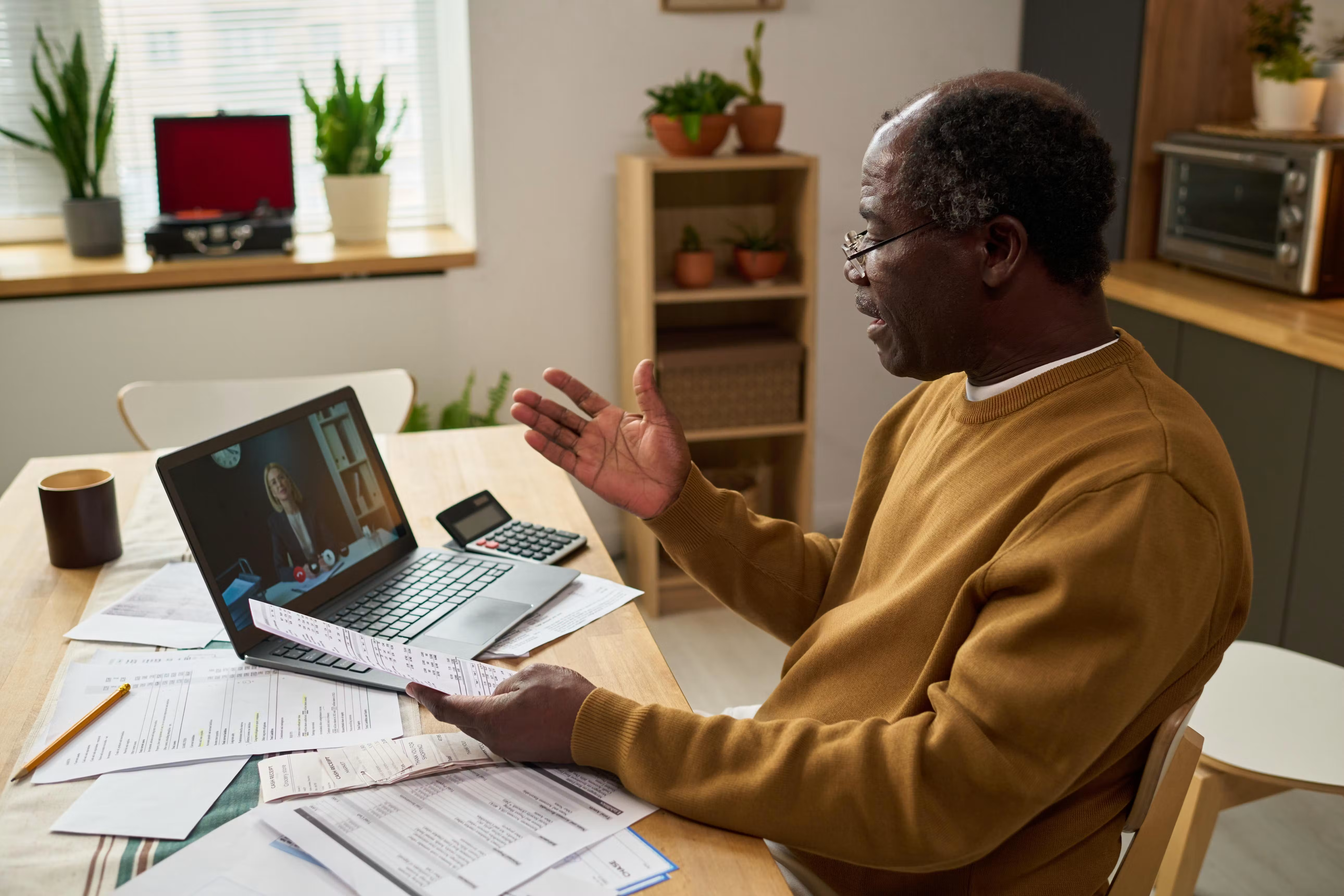

Work From Home after 55
Could you work from home after 55? Explore remote work, self-employment, and online business to choose the home-based income path that suits you.
When people imagine changing their relationship with work later in life, the phrase that usually comes up first is simple: "I’d like to work from home." It is easy to see why.
The idea of ditching the daily commute, skipping rigid office politics, and working in comfortable surroundings is universally appealing.
However, working from home is a location, not an income model.
Saying you want to work from home explains where you want to sit, but not how you'll earn money. From the same spare bedroom or kitchen table, you could work remotely for a company. You could freelance or consult for multiple clients. Provide a local service, run a home-based business, or build an asset-based online business.
While all of these happen from home, they represent vastly different ways to earn an income—each with distinct levels of risk, freedom, and effort.
(Related reading: Don’t Want Another Full-Time Job After 55? What Are Your Alternatives?)
What Are You Really Looking For When You Say “Work From Home”?
Before choosing a path, it pays to dig underneath the phrase and understand your true motivation. When you say you want to work from home, you may actually be seeking to avoid a time-consuming commute, gain more control over your daily schedule, or accommodate family and personal commitments.
For others, the goal is to escape the rigid structure of a five-day workplace or achieve greater overall independence.
Once you understand why home-based work appeals to you, deciding what kind of work makes sense becomes significantly easier.
Working From Home Doesn't Necessarily Mean Working for Yourself
It is worth separating your location from your employment status. Remote employment allows you to keep the traditional structure of work while changing your physical location.
This arrangement keeps regular, predictable wages, an employer who handles administrative overhead, defined job responsibilities, and clear expectations.
If you generally enjoy your profession but dislike commuting or rigid office attendance, seeking remote employment in your existing field might be all you need. That is a completely legitimate goal.
However, if what you are truly seeking is greater autonomy, control over your schedule, or long-term ownership of an asset, staying an employee—even a remote one—may still leave you feeling restricted.

What Could You Actually Do From Home?
Rather than scrolling through endless lists of generic work-from-home jobs, it helps to evaluate the three broad operational models available to you.
The first model is remote employment, where you still work for an employer, and your workplace has shifted to your home. In this setup, you swap physical attendance for digital check-ins, but your time and tasks remain bound to company directives.
The second model is self-employment, such as freelancing or consulting, where you sell your existing skills, time, or services directly to clients. You control your pricing and client selection, but you still trade hours for dollars, meaning income stops when you stop working.
The third model is a home-based business focused on online assets or products, where you build and operate an enterprise that you own. Instead of merely selling your time, you create systems, content, or products that can generate revenue independently of your direct presence.
These three models balance certainty, responsibility, flexibility, and ownership in fundamentally different ways.
Home-Based Doesn't Automatically Mean "Online"
Another common misconception is that home-based work automatically requires running a complex tech business.
A bookkeeper, management consultant, tutor, copywriter, or tax adviser can operate primarily from home without building a formal online business. For these professionals, the internet is simply a practical communication tool for client acquisition and service delivery via email or video calls.
An online business, by contrast, uses the internet as a core mechanism to create, scale, and monetize value.
(Explore further in our guide: Online Business After 55)
What Does Working From Home Actually Require?
While eliminating the daily commute sounds wonderful, working from home comes with its own real-world demands. Without a boss or office culture to keep you accountable, you must build the self-discipline to stay focused.
Household chores, television, and family commitments can easily bleed into your work hours if you don't set clear boundaries and separate your professional tasks from your personal life.
Additionally, you need a comfortable working knowledge of basic digital tools such as email, video meetings, cloud storage, and standard software. Most importantly, in self-employment or business ownership, no one hands you a paycheck, meaning you must take full responsibility for generating revenue.
Removing the workplace doesn't remove the work.
What Does It Cost to Start Working From Home?
A myth is that working from home requires thousands of dollars in commercial setups, high-end computers, multi-monitor displays, and expensive software subscriptions.
For most modern digital and service work, you likely already own what you need to get started: a reliable computer, a stable internet connection, a phone, and a quiet, practical place to focus.
Our core rule at Senior Entrepreneur Hub always applies: Evaluate first. Buy later. Do not invest heavily in tools or subscriptions until your revenue model requires them.
Could Your Existing Experience Give You a Head Start?
When considering working from home, many people mistakenly assume they need to learn an entirely new trade from scratch. In reality, your greatest advantage after 55 is the depth of knowledge you've accumulated over decades.
Consider the professional expertise you take for granted that others might pay to learn, as well as your industry knowledge, problem-solving abilities, and practical skills. You can easily repurpose decades of communication experience for remote work without starting from zero.
Where Does an Online Business Fit?
For someone seeking home-based flexibility, low initial overhead, schedule control, and the ability to build an asset gradually, an online business can be an attractive option.
However, keep in mind that working online isn't the business model itself; it is simply the environment in which the business operates. You still need to decide how you deliver value and generate revenue.
Where Does Affiliate Marketing Fit?
Affiliate marketing is a popular online business model for working from home because it requires no physical inventory, manufacturing, or commercial premises.
The merchant handles transactions, payment processing, and product fulfillment. Startup requirements are also modest, and the model can grow gradually alongside other commitments.
However, none of those low-friction advantages remove the need to learn how the business actually works. Success still depends on creating quality content, understanding an audience, generating traffic, earning trust, making helpful recommendations, measuring performance, and continuously improving your approach.
(Learn more in Affiliate Marketing for Beginners and Affiliate Marketing After 55)
Could Working From Home Actually Suit You?
To wrap up your evaluation, ask yourself if you genuinely enjoy working independently without external supervision and whether you can structure and manage your own schedule effectively.
Consider whether you have a practical space at home to work without constant interruption and if you feel comfortable learning and using standard digital tools.
Finally, decide whether you prefer predictable employment over greater ownership, whether you need income immediately or have room to build an asset over time, and whether you already have experience you can use.
Working from home isn't automatically easier than going to a traditional job. But for the right person, it offers something immensely valuable: greater control over how work fits into the rest of your life.
What’s Next?
This leads directly to our next critical question. If you’ve spent decades accumulating knowledge, skills, and real-world experience, do you really need to start from zero, or could what you already know become the foundation for your next income source?
Next Article: Could You Use the Skills and Experience You Already Have?
