The Decision To Engage

Why participation matters, how action creates opportunity, and why understanding alone is not enough for meaningful progress.
When Understanding Is No Longer Enough
This article explores why understanding often fails to lead to action, and what it takes to truly move from knowing to doing. I’ll clarify the difference between evaluation and participation and show why, in healthcare, business, and life, the decision to engage marks the start of real progress. While knowledge is vital, only participation unlocks opportunity, growth, and achievement.
I’ll draw on lessons from healthcare, business, and personal experience to illustrate how shifting from evaluation to participation drives progress.
From Understanding to Action
Knowledge seems like the answer to many problems. The more we understand, the better decisions we make. This lesson feels intuitive—and often true.
However, my perspective evolved as I gained more experience.
To illustrate this, let me begin with the field that most shaped my perspective: healthcare.
One of the privileges of working with people over such a long period is that you begin to notice patterns. Not the kind of patterns found in textbooks or academic journals, but the patterns that emerge from watching hundreds and eventually thousands of people navigate the realities of their own lives.
At first, those patterns are hard to see because each patient looks different. Different ages. Different occupations. Different personalities. Different injuries. Different circumstances.
One person struggles with persistent back pain that has robbed them of the enjoyment of golf. Another is recovering from an injury that threatens their ability to work. A third wants to remain active enough to keep up with grandchildren who seem to possess endless energy.
On the surface, their situations appear unrelated.
Over time, though, I began to notice recurring themes.
The physical problem that brings a person into the clinic is rarely the whole story. People do not simply arrive carrying pain. They arrive carrying frustration, disappointment, concern about the future, and, occasionally, fear. The golfer is not merely worried about a sore back. He is worried about losing something he loves.
The grandmother is not simply concerned about a stiff knee. She is concerned about maintaining her independence. The tradesman is not thinking only about an injured shoulder. He is wondering what happens if his body can no longer perform the work that has supported him and his family for decades.
The injury may be physical, but the questions it creates are often deeply personal.
Together, we would begin the process of understanding what had gone wrong. We would discuss symptoms, review movement patterns, identify areas of weakness, and talk about what needed to change.
Eventually, we would develop a treatment plan to help them move towards recovery. In most cases, patients left with a clear understanding of the problem and a practical plan for addressing it.
Despite this thorough process, I began to see that understanding alone rarely determined the outcome.
Some patients embraced the process. They accepted that recovery was not something that would be done for them, but something they would have to participate in themselves. Over the following weeks, they performed the exercises, made adjustments, and gradually learned how their bodies responded. Small improvements began to appear.
Getting out of bed became easier. Walking became more comfortable. Activities that had previously been avoided slowly returned. Through participation, they gained something that could never have been handed to them during a consultation: experience. Their bodies provided feedback, their confidence grew, and their understanding became grounded in reality rather than theory.
Other patients followed a different path. Their intention to improve was genuine. They wanted less pain, greater freedom of movement, and a return to the activities they enjoyed. Yet somewhere between understanding the plan and implementing the plan, the process stalled. The exercise sheet found a permanent home on the kitchen bench.
A busy week became a busy month. Good intentions slowly gave way to familiar routines. Nothing dramatic happened. There was no conscious decision to abandon the process. Life continued as it always had.
When these patients returned weeks later, their frustration had grown. They understood what needed to happen, but little had changed. Knowledge and opportunity remained; what was missing was engaging with the process.
I found that the difference between these two groups was rarely due to intelligence, motivation, or access to information. Instead, it often came down to a conscious decision to engage with the process.
The decision to engage.
This insight grew in significance beyond healthcare, applying to learning, careers, relationships, personal growth, and even online business.
Over the years, I have met many thoughtful people wanting to improve their lives, adapt, and create opportunities for themselves and their families in a rapidly changing world.
In many cases, what was missing was the decision to turn understanding into action, not new information or opportunity.
This distinction matters because understanding is not the same as participation, and participation is what leads to real change.
Knowledge helps us understand what may be possible.
Participation allows us to discover what is actually possible.
This lesson shaped my healthcare experience, was reinforced in online business, and informs the discussions that follow.
In almost every worthwhile pursuit, there comes a time when understanding alone is no longer enough. Here is my central argument: progress depends on making a conscious decision to engage—shifting from knowing to doing. Action, not just knowledge, is essential to move forward.
This idea guides what follows.

The Limits of Evaluation and the Nature of Certainty
One of the assumptions I carried for many years was that confidence came before action.
It seemed logical enough. Surely people who made important decisions did so because they felt ready. Surely they possessed a level of certainty that allowed them to move forward without hesitation. From the outside, successful people often seem successful. Their decisions seem deliberate. Their direction appears clear. Their confidence appears unwavering.
Yet, when I look back on my own life, my experience has often been different.
When I reflect on the most significant decisions I have made throughout my life, I struggle to identify many instances in which certainty arrived before action. More often than not, certainty was absent. What existed instead was a combination of curiosity, hope, caution, uncertainty, and a belief that the opportunity before me was worth exploring.
When I entered healthcare, I did not possess a complete understanding of where that journey would lead. I could not have predicted the people I would meet, the lessons I would learn, or the experiences that would shape my understanding of human behavior over the following decades. I knew enough to take the first step.
A similar pattern emerged when I became interested in online business.
Like many people, I began with questions rather than answers.
Could I learn the necessary skills?
Would the effort be worthwhile? Was I capable of adapting to technology that seemed to change every few months? Was there genuinely an opportunity here, or was I chasing another possibility that would lead nowhere?
Those questions did not disappear overnight.
Some of these questions lingered for quite some time.
What changed was my willingness to move forward despite the absence of certainty.
While this distinction may seem subtle, I believe it helps explain why so many thoughtful people become stuck.
People often assume they need more information before making a decision. Sometimes that is true. Sometimes further research is sensible and necessary. However, there comes a point at which additional information no longer solves the problem, because the problem itself has changed.
The issue is no longer knowledge.
The issue is uncertainty.
And uncertainty is a very different challenge.
Information can help us understand how something works. It can explain what others have experienced. It can help us evaluate risks and opportunities. What information cannot do is completely remove the uncertainty attached to a future that has not yet occurred.
This is why certainty is so difficult to obtain.
The future refuses to reveal itself in advance.
No amount of research can tell us exactly how a new career will unfold. No amount of preparation can guarantee how a business will develop. No amount of planning can fully predict the opportunities, setbacks, lessons, and surprises that lie ahead.
The future must eventually be experienced before it can be understood.
I think many intelligent people misunderstand this relationship. They interpret uncertainty as evidence that they are not ready. They continue searching for one final piece of information, one final book, one final article, or one final opinion that will finally remove their doubts and provide the confidence they seek.
Yet confidence rarely arrives that way.
The patient recovering from injury does not gain confidence by endlessly studying rehabilitation. Confidence builds as the exercises are performed and the body begins to respond positively. The golfer does not gain confidence by reading about the golf swing. Confidence emerges through practice, feedback, and experience. The writer gains confidence by writing. The business owner gains confidence as they build.
In each case, confidence is created through participation rather than preparation alone.
This is not an argument against learning. Learning matters. Evaluation matters. Preparation matters. Throughout this website, I have encouraged all three.
What I am suggesting is that meaningful progress requires more than understanding; it requires a deliberate decision to act.
There comes a point where preparation has fulfilled its purpose. It has provided enough understanding for an informed decision to be made. Continuing to search for certainty beyond that point often creates the illusion of progress while quietly postponing the very experiences that would provide the answers we are seeking.
That is why I have come to view certainty differently over the years.
I no longer see it as a requirement for participation.
I see it as something that develops gradually through participation itself.
Many of the answers we seek are not waiting for us at the beginning of the journey.
They reveal themselves along the way.

The Power and Limits of Intention
One of the most interesting observations I have made over the years is that intention often feels remarkably similar to progress.
That may sound like a strange statement at first, yet I suspect most people have experienced it at some point in their lives.
Consider what happens when we decide to improve something important. We decide to lose weight, improve our fitness, learn a new skill, start a business, or pursue an opportunity that could improve our future. The moment the decision is made, something shifts within us. We feel optimistic. Encouraged. Motivated. We begin imagining what life might look like if the change is successful.
In our minds, we can already see the outcome.
We picture ourselves becoming healthier. We picture ourselves learning something new. We picture ourselves building something meaningful. We picture ourselves becoming the kind of person capable of achieving those things.
There is nothing wrong with this process. In many respects, it is an essential part of growth. Before we can move towards a different future, we must first be able to imagine it.
The difficulty arises when imagination begins to replace participation.
The future we imagine is attractive partly because it remains untouched by reality. Inside our imagination, there are no setbacks, no unexpected challenges, and no moments where our assumptions are tested. The vision remains perfect because it has not yet encountered the practical realities of implementation.
Reality changes that. It provides feedback, exposes weaknesses, and reveals gaps in our understanding. Sometimes, what appears straightforward from a distance becomes considerably more complex up close.
For many people, this is uncomfortable.
It is much easier to imagine writing a book than it is to sit down and write one. It is much easier to imagine building a business than to learn the skills required to build one. It is much easier to imagine becoming fit than to exercise consistently when motivation fades, and discipline becomes necessary.
This is not a criticism of human nature.
It is simply an observation.
There is something comforting about intention because intention allows us to enjoy the possibility of change without exposing ourselves to the uncertainty that change requires. We can imagine a better future without risking disappointment. We can imagine success without confronting failure. We can imagine progress without discovering how much effort progress may actually require.
The danger is that intention can create the feeling of movement while allowing us to remain exactly where we are.
I saw this repeatedly throughout my healthcare career.
Patients would leave the clinic genuinely committed to improving their condition. They understood the exercises. They understood why the exercises mattered. They fully intended to perform them. Yet intention and participation are not the same thing. One exists in the mind. The other exists in the real world.
The patient who intends to exercise and the patient who exercises may share the same goal, but they are engaged in very different activities.
One is imagining improvement.
The other is creating the conditions that enable improvement.
That distinction eventually became impossible for me to ignore.
The same pattern appears in learning, careers, relationships, and online business. Many thoughtful people spend years gathering information, discussing possibilities, and imagining future outcomes. The effort is often genuine. The interest is genuine. The desire is genuine.
What is missing is participation.
And participation changes everything.
The moment we become involved, possibility encounters reality. Ideas are tested. Assumptions are challenged. Weaknesses become visible. Skills begin developing. Genuine learning starts to occur.
Most importantly, participation provides something that intention never can.
Experience.
Experience is where understanding becomes personal. It is where knowledge stops belonging to books, videos, and other people and begins belonging to us.
That is why intention, while valuable, can never be the destination.
Its purpose is to point us towards action.
At some point, every worthwhile intention asks the same question:
“Are you prepared to become involved?”
That is where imagination ends.
And participation begins.
When Evaluation Becomes a Place to Hide
I have always believed that evaluation is one of the most important stages of any significant decision.
Throughout this website, I have encouraged people to ask questions, conduct research, compare opportunities, and avoid making emotional decisions based upon hype, urgency, or unrealistic promises. Thoughtful evaluation protects us from many of the mistakes that occur when enthusiasm outruns understanding.
The problem is not evaluation.
The problem occurs when evaluation quietly transforms into avoidance.
That transition is often difficult to recognize because the behavior still appears productive. We are reading articles, watching videos, listening to podcasts, comparing options, and gathering information. Everything looks sensible from the outside.
In fact, everything may still feel sensible from the inside. Yet something important has changed. The purpose of the activity is no longer understanding; the purpose has become postponement. At that point, evaluation stops moving us towards a decision and starts protecting us from one.
I have seen this happen in many areas of life. Some people spend years researching fitness without ever establishing an exercise routine. Others spend years discussing business ideas without ever attempting to build one. Still others spend years talking about retirement plans without taking meaningful steps towards creating them.
The intention, interest, and effort are all genuine. What is absent is commitment. That distinction matters because evaluation and participation produce very different outcomes. Evaluation creates understanding; participation creates experience. Both are valuable and necessary, but they are not interchangeable.
No amount of reading about exercise strengthens a muscle. No amount of studying a golf swing improves a golf game. No amount of online research on business development develops the skills required to build one. Eventually, every worthwhile pursuit reaches a point where learning must be accompanied by doing.
That moment is often uncomfortable because participation introduces vulnerability. As long as we remain in evaluation mode, nothing is required of us. We can continue gathering information without exposing ourselves to uncertainty. We can continue discussing possibilities without risking disappointment. We can continue imagining outcomes without determining whether they are achievable.
Evaluation feels safe. Participation feels uncertain. And that is precisely why many people remain evaluators far longer than necessary—not because they lack intelligence or motivation, but because participation demands something evaluation does not: responsibility.
The moment we become involved, the outcome is no longer theoretical. We can no longer hide behind information or tell ourselves that one more article, course, or opinion will provide the answer. Reality begins providing the answer—and reality has a habit of being both a demanding teacher and an honest one.
This is why I have come to view evaluation differently over the years. Evaluation is not the destination; it is preparation. Its purpose is to help us make a thoughtful decision. It was never intended to become a permanent address.
At some point, the question changes from “What else can I learn?” to “Have I learned enough to begin?” That is often the moment where genuine progress starts.
Participation Creates Access, Not Automatic Rewards
One mistake we must avoid is making participation sound easier or more powerful than it actually is.
Participation does not automatically reward anyone.
It does not hand out success simply because a person becomes involved. It does not guarantee income, confidence, achievement, recognition, or progress. Life is not that simple, and anyone with enough lived experience knows it.
What participation does is something different.
Participation creates access.
It places us inside an experience rather than outside it. It moves us from observation into involvement. It allows us to encounter the realities, opportunities, and challenges that can only be understood through direct experience.
That distinction is important because many people misunderstand the relationship between participation and results.
Consider a patient beginning a rehabilitation program. The exercises themselves do not create strength. The exercise sheet does not create strength. Understanding the exercises does not create strength.
Strength develops because the patient performs the exercises consistently over time. The exercises provide the pathway, but the patient must still walk it. The opportunity for improvement exists from the moment the program begins, yet the improvement itself depends on what the patient chooses to do with it.
The same principle applies to almost every worthwhile pursuit.
A person does not become a writer by purchasing a book about writing. A golfer does not improve simply because they buy a new set of clubs. An aspiring business owner does not create a business merely by joining a training program. These things may provide direction, structure, and support, but they do not replace effort. They create access to the work that must eventually be done.
This is where I believe many people misunderstand opportunity.
They imagine opportunity as something complete. Something that arrives fully formed and ready to deliver a result. In reality, opportunity often resembles a doorway rather than a destination. It provides access to a pathway, but it does not walk the pathway on our behalf.
The opportunity to become stronger exists when the patient begins exercising. The opportunity to become a better golfer exists when the golfer begins practicing. The opportunity to develop new skills exists when learning begins. The opportunity to build something meaningful exists when participation starts. What happens after that depends upon the individual. This is not intended to discourage anyone.
In fact, I think it should be encouraging.
Because it reminds us that progress is rarely determined by luck alone, progress is often influenced by the decisions we make after participation begins. The willingness to learn. The willingness to adapt. The willingness to remain involved when things become difficult or when results arrive more slowly than we hoped.
Looking back over my own journey online, I can see this principle everywhere.
The websites did not appear because I became interested in online business. They appeared because I stayed involved long enough to learn the skills required to build them. The content did not appear because I joined a learning environment. It appeared because I continued writing, learning, and refining over time. The podcasts, videos, and communities that exist today emerged from the same process.
Participation gave me access.
What followed depended upon what I chose to do with that access. That is why I believe participation matters so much—not because it guarantees rewards, but because it creates the possibility of rewards. Participation opens access to experiences, lessons, opportunities, and pathways that remain unavailable to those who never become involved.
The rewards themselves still have to be pursued. The work still has to be done. The lessons still have to be learned. Yet none of those things can occur until participation begins. That is why participation matters. Not because it guarantees success, but because it creates the opportunity for success to become possible.
Opportunity Belongs to Participants
One of the observations that has fascinated me throughout life is that opportunity rarely arrives in the form we expect.
When people think about opportunity, they often imagine something obvious. A promotion. A business idea. A lucky break. A chance encounter that changes everything. Occasionally, life unfolds that way.
More often, however, opportunity arrives quietly.
It may begin as a conversation. A skill that needs to be learned. A problem that requires solving. A project that initially appears insignificant. In many cases, the opportunity is not even recognized as an opportunity when it first appears.
That has certainly been my experience.
Looking back over the most important developments in my own life, very few arrived fully formed and clearly labeled. Most emerged gradually. At the time, they appeared ordinary, sometimes even inconvenient. It was only later, with the benefit of hindsight, that their significance became clear.
This is one of the reasons I believe participation matters so much.
Participation places us in environments where opportunity can emerge.
The person who never enters the room cannot have the conversation taking place inside it. The person who never begins learning cannot discover where that learning may lead. The person who never attempts to build something cannot discover what becomes possible through the process of building.
In many cases, the opportunity does not exist at the beginning of the journey.
It develops because participation creates the circumstances in which it can develop.
I witnessed this repeatedly throughout my years in healthcare. Patients often began treatment with a very specific goal in mind. They wanted less pain. Better mobility. Greater independence. Yet as they became involved in their recovery, other benefits frequently emerged. Confidence improved. Activity levels increased. Lifestyle habits have changed. Relationships improved. The original goal remained important, but participation often revealed possibilities that had never been part of the original plan.
The same thing happens in learning.
A person begins developing one skill and discovers several others along the way. They join a community seeking answers to one question and encounter people who introduce entirely new possibilities. They pursue one goal and gradually realize that another opportunity is even better aligned with their interests, abilities, and aspirations.
When I look back over my own online journey, I see this pattern everywhere.
The websites were not part of some carefully designed master plan. The articles, podcasts, videos, and communities that eventually emerged were not mapped out years in advance. Most grew naturally from opportunities that revealed themselves through participation. One lesson created the need for another lesson. One skill enabled the development of the next. One experience opened the door to possibilities that had been completely invisible beforehand.
Had I remained focused on obtaining complete certainty before becoming involved, many of those opportunities would have remained permanently hidden.
That is an important point.
Participation does not simply help us pursue opportunity; it helps us recognize it. The observer sees only what is visible from the outside, while the participant sees what becomes visible from within. That is why I have come to believe that opportunity belongs to participants—not because they possess special knowledge or are guaranteed success, but because participation changes what becomes visible. The future rarely unfolds all at once.
More often, it reveals itself one opportunity at a time.
And those opportunities tend to reveal themselves most clearly to those willing to become involved.
The Decision Belongs to You
If there is one lesson that both healthcare and online business have reinforced throughout my life, it is that nobody can make an important decision on another person’s behalf.
People can educate us. They can guide us, share their experiences, and explain what worked for them and what did not. They can help us avoid mistakes, identify opportunities, and better understand the realities of a particular path. What they cannot do is remove the responsibility for making the decision. That responsibility always remains with the individual.
I saw this repeatedly throughout my years in healthcare.
Patients would often ask whether I thought a particular treatment approach would help them. It was a reasonable question and one I was always happy to answer. I could explain what I had observed in similar cases. I could discuss the likely benefits. I could explain the risks, limitations, and alternatives. I could provide as much information as possible to help them make an informed choice.
What I could never do was choose for them.
Nor would I have wanted to.
The reason is simple.
A decision that truly matters must ultimately belong to the person who will live with its consequences.
They are the person who must commit to the rehabilitation program, perform the exercises, and remain consistent when motivation fades and progress seems slower than expected. Without that personal commitment, even the best advice in the world has limited value. The same principle applies far beyond healthcare.
Throughout this article, we have explored the relationships among understanding, evaluation, participation, opportunity, and experience. Each plays an important role. Understanding helps us make sense of the world. Evaluation helps us make informed decisions. Participation creates access. Opportunity emerges through involvement. Experience deepens understanding.
Yet none of these things removes the need for a decision.
Eventually, every worthwhile journey reaches a point where no further article, video, mentor, friend, family member, or expert can provide the answer. The information has been gathered, the questions have been asked, the possibilities explored, and the advantages and disadvantages considered. At that point, the issue is no longer understanding—the issue is choice.
For many people, this is the most uncomfortable stage of all, because making a decision means accepting responsibility for the outcome. As long as we remain in evaluation mode, we can postpone that responsibility. We can continue researching, comparing options, and searching for certainty. Yet sooner or later, we reach the limits of what evaluation can provide. The future refuses to reveal itself in its entirety in advance.
There will always be unanswered questions, elements we cannot fully predict, and risks we cannot entirely remove. That is not a flaw in the process; that is the nature of life itself.
Every meaningful decision we make is taken with incomplete information. We choose careers without knowing exactly where they will lead. We enter relationships without knowing exactly how they will unfold. We move house, change jobs, start businesses, and pursue new interests without any guarantee of success. If complete certainty were required before action, very little would ever happen.
What matters is not certainty. What matters is whether we have conducted enough thoughtful evaluation to make an informed decision. That has always been the philosophy behind this website: Evaluate first. Understand what you are considering. Ask questions. Think carefully. Take your time.
But eventually, a different question begins to emerge—not “What else do I need to know?” but “What am I going to do with what I already know?” That is where the decision lives—not in the information, not in the opportunity, not in the opinion of others. It lives within the individual.
And that brings us to the final point of this entire discussion. The purpose of this article has never been to convince you to do anything. It has been to share an observation that life, healthcare, and online business have repeatedly reinforced.
Understanding matters. Evaluation matters. Preparation matters.
But there comes a point where understanding alone is no longer enough.
At some stage, every meaningful journey asks the same question: Will you remain an observer, or will you choose to engage? Only you can answer that. And only you can make the decision.
Ultimately, the aim of this article is simple: to encourage you to recognize when understanding must give way to participation, and to provide the clarity and confidence needed to take that first step.
My Own Decision to Engage
Everything I have written in this article is based upon a simple observation.
At some point, understanding is no longer enough.
Eventually, a decision has to be made.
That was certainly true in my own life.
When I first became interested in online business, I was not looking for certainty. Like most people, I was looking for understanding. I wanted to know whether the opportunity was genuine. I wanted to understand how it worked. I wanted to know which skills would be required and whether they could realistically be learned.
The questions were sensible.
In many ways, they were necessary.
The decision to engage did not happen overnight. It emerged gradually through a process of learning, evaluation, and increasing involvement. Looking back now, what strikes me most is not how much I knew at the beginning. It is how little I knew compared to what participation would eventually teach me.
At the time, none of the things you see today existed. The websites did not exist. The articles did not exist. The podcasts did not exist. The videos did not exist. The social communities did not exist. Most importantly, the understanding behind them did not exist. All of those things emerged through participation.
The decision to become involved placed me on a path that revealed opportunities, skills, and experiences I could never have predicted from the starting line. Along the way, there were mistakes, frustrations, lessons, and periods of uncertainty. There were times when progress felt slow and times when new challenges appeared just as old ones had been solved.
That is the nature of any worthwhile journey. What participation provided was not certainty—it provided experience. And experience gradually transformed information into understanding.
Over time, I began to appreciate something that healthcare had been teaching me for years: the people who make progress are not necessarily those who know the most at the beginning. More often, they are the ones willing to remain engaged long enough to learn from the process. That has certainly been true in my own case.
Everything I have built online emerged from that decision to engage—not because I possessed special knowledge or extraordinary ability, but because I eventually reached the point where evaluation had fulfilled its purpose and participation needed to begin.
That is why I feel comfortable sharing this journey with others. Not because I have all the answers. Not because my path is the only path. But because I have walked it myself. And based on that experience, I have reached conclusions that I believe may be valuable to others who find themselves standing at the same crossroads I once faced.

Continue Your Evaluation Here
If you have read this far, you already understand the article’s central message.
The purpose of evaluation is not to eliminate every uncertainty.
The purpose of evaluation is to help us make informed decisions despite uncertainty.
Throughout this website, I have encouraged people to think carefully before committing themselves to any opportunity. I believe thoughtful evaluation is one of the most important responsibilities we have when making decisions that may influence our future. It is why I have spent so much time discussing adaptation, learning, decision-making, and participation rather than simply telling people what they should do.
The goal has never been to persuade.
The goal has been to help people understand.
Over the years, I have evaluated many opportunities, explored different business models, purchased courses, made mistakes, learned lessons, and gradually formed my own opinions about what works and what does not. Like most people, I did not begin with certainty. I began with questions.
What eventually emerged from that journey was not simply websites, articles, podcasts, and videos. More importantly, it gave me a deeper understanding of how learning, participation, and experience work together to create progress.
Based on that experience, there is one learning environment I personally feel comfortable recommending—not because it guarantees success, removes risk, or will be the right fit for every person, but because it played a significant role in my own journey and provided the education, structure, and guidance that allowed me to move from observer to participant.
You may reach a different conclusion after conducting your own evaluation. That is entirely your decision. In fact, it is exactly what I encourage you to do.
However, if you would like to continue your evaluation, learn more about the program, examine it for yourself, and decide whether it may be appropriate for your own circumstances, you can do so below.
The decision, as it always has been, belongs to you.
What Happens After Participation?
Participation is not a destination.
It is a decision to become involved in shaping your future rather than simply observing it.
For some people, participation may mean volunteering, mentoring, learning a new skill, starting a project, or pursuing a long-held interest.
For others, it may mean exploring the possibility of building an online business.
If your participation journey has led you to consider that path, the next question becomes:
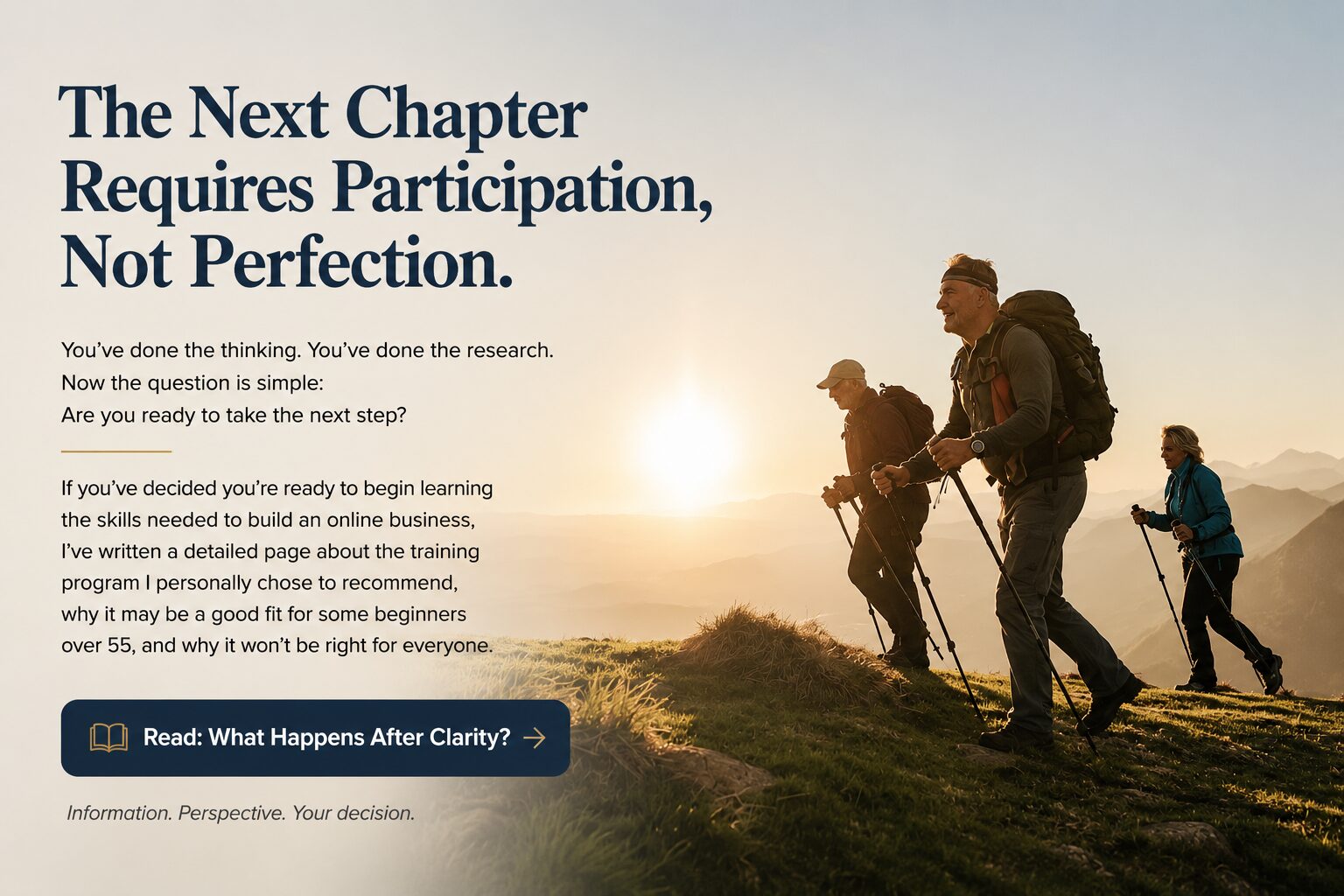
Where do you begin?